What Is Paintless Dent Repair?
Paintless dent repair reshapes an existing dented panel back toward its original form, rather than covering the damage with body filler and a fresh coat of paint. A trained technician works the metal itself — from behind the panel, or occasionally from the front using a specialized glued tool — until the dent is worked back out. Because the process doesn't cut, sand, or repaint the panel, the factory finish stays exactly as it was manufactured, which is a meaningful difference from traditional bodywork.
PDR isn't a shortcut or a lesser version of "real" repair — for the right kind of damage, it's often the better option, since it avoids introducing new paint that has to be color-matched and blended into the surrounding factory finish. That said, it's not a universal fix. Whether a specific dent is a good candidate depends on several factors we walk through during inspection.
How PDR Works
The process starts with access. For most dents, a technician needs to reach the underside of the panel, which sometimes means removing interior trim, tail lights, or other components temporarily. Once there's access, specialized metal rods and tools are used to apply slow, controlled pressure to the back of the dent, gradually pushing the metal back toward its original contour rather than forcing it in one motion.
For dents where the back of the panel isn't reachable, technicians sometimes use a glue-pull technique instead — a small tab is glued to the front of the dent, and a specialized tool pulls the metal outward using that tab. Throughout the process, technicians rely on specialized inspection lighting to see the panel's surface reflection change as the metal moves, which is how they judge progress without being able to see the dent from the angle most people would expect. It's a gradual process, not an instant fix, and a single dent can take anywhere from several minutes to a couple of hours depending on its size and depth.
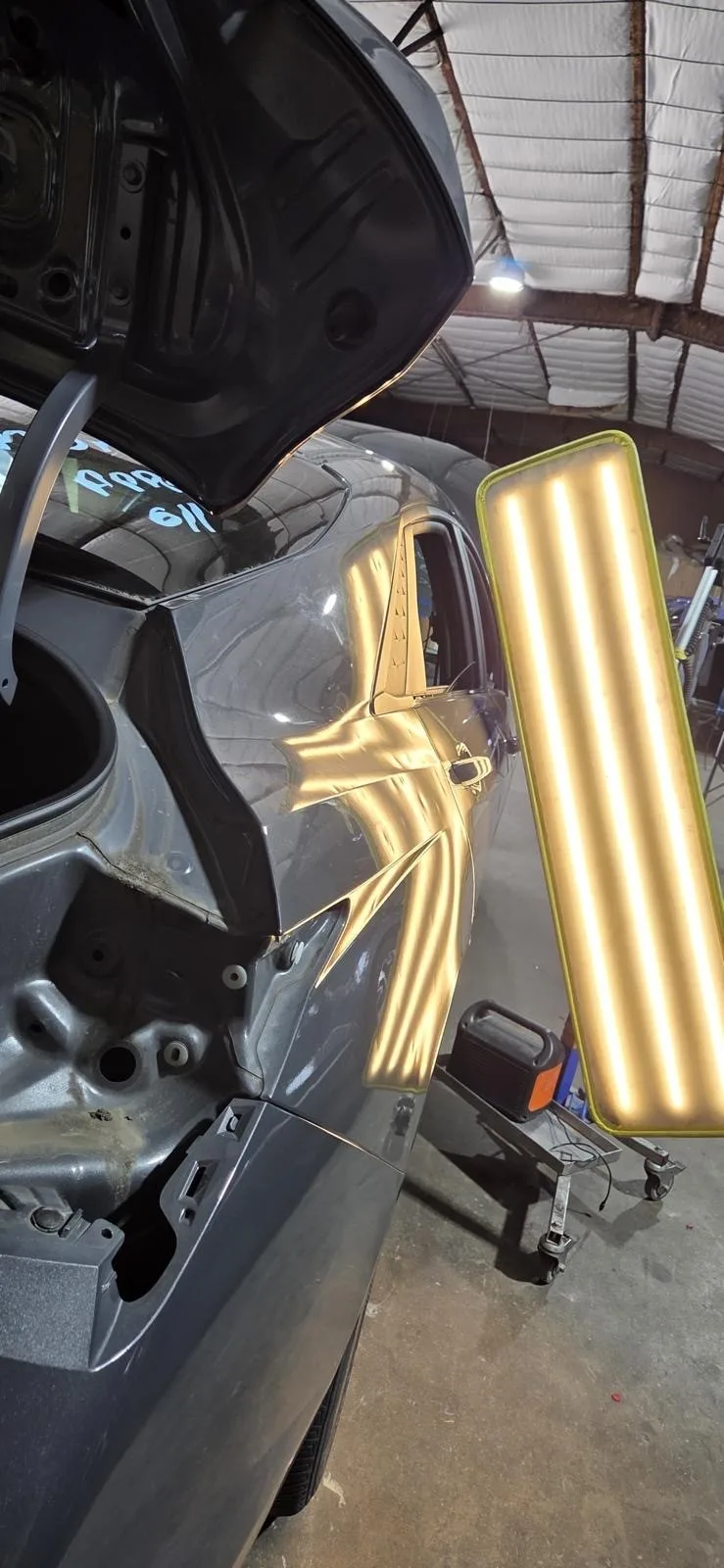
Types of Damage PDR May Repair
PDR is commonly used for hail dents, door dings from shopping carts or adjacent car doors, minor dents along body lines, shallow creases, and small dents from low-speed contact like a bump in a parking lot. That said, every dent is different, and the same size dent can be a great candidate on one panel and a poor candidate on another depending on the metal's shape, the panel's material, and how the impact affected the surrounding area. We don't quote PDR suitability without actually inspecting the vehicle in person.
Benefits of PDR
The clearest benefit of PDR is that it preserves the factory paint when the damage qualifies, which matters both for how the vehicle looks and for maintaining an unbroken paint history on the vehicle. Because there's no filling, sanding, priming, or repainting involved, PDR repairs can often move faster than a comparable conventional repair — though this isn't universal, since a vehicle with many dents spread across several panels can still take meaningful time even without paint work.
PDR also tends to use fewer materials overall, since there's no filler, primer, paint, or clear coat involved in a typical repair — a modest environmental upside compared to full refinishing. And because the original panel and paint remain intact, PDR can help protect a vehicle's value compared to leaving hail damage unrepaired or opting for a lower-quality filler-based repair.
Factory Finish Preserved
No filler, sanding, or repainting on qualifying repairs.
Often Faster
No paint curing time needed for most qualifying repairs.
Protects Value
Keeps the original panel and paint history intact.
Fewer Materials Used
No filler, primer, or paint needed for qualifying repairs.
PDR, Paint, and When You Might Need Both
Most dents can be worked back into shape using PDR, even in cases where the paint needs some attention afterward. If paint has cracked or is missing over a dent, that section may need conventional repair and refinishing to fully restore the finish — but the metal underneath can often still be corrected with PDR first. Because Prime CRS handles both paintless dent repair and conventional collision repair in-house, we're able to combine techniques on the same vehicle when that gives you the best result, rather than being limited to one method.
The clearest cases where we'd move to full conventional repair are structural damage or a panel that needs to be replaced outright rather than reshaped. Short of that, we'll always start by seeing how much of the repair PDR can handle, since it's often the faster, lower-cost path — bringing in conventional bodywork or paint only where it's actually needed. We'll walk you through exactly what your vehicle needs after a free, in-person inspection.
PDR for Hail Damage
Hail damage is one of the most common reasons vehicles come to us for PDR, largely because a single storm typically produces dozens of small, shallow dents rather than one large impact. That pattern — many shallow dents rather than a few deep ones — is often well-suited to PDR, but it also means estimating the work accurately takes more time than a single-dent repair, since every dent on every affected panel needs to be accounted for individually. For a closer look at hail-specific repair, including our inspection process and insurance claim assistance, visit our hail damage repair page.
PDR for Door Dings and Minor Dents
Not every PDR repair follows a hailstorm. Shopping cart dings, a neighboring car door bumping yours in a parking lot, or a small dent from a stray object are all common reasons customers bring in a single panel for repair. These repairs are typically more straightforward to estimate than hail damage, since there's usually one dent (or a small handful) to evaluate rather than dozens spread across multiple panels, though the same suitability factors — paint condition, depth, and access — still apply.
Factory Finish Preservation
When a dent qualifies for PDR, the panel keeps its original factory paint rather than being resprayed. That matters for a few reasons: it avoids introducing a repainted section that has to be color-matched to the rest of the vehicle, it keeps the vehicle's paint history unbroken for anyone who checks it later (such as during a used-car inspection), and it sidesteps the small risk of a visible color or texture mismatch that can sometimes come with refinishing work. We wouldn't promise that PDR guarantees a higher resale price — that depends on many factors beyond paint — but retaining original, undisturbed paint is generally viewed as a plus by most buyers and appraisers.
What Affects PDR Pricing
We don't publish fixed PDR prices because the cost genuinely depends on the specifics of the damage. Larger and deeper dents generally take longer to work than small, shallow ones. Location matters too — a dent near a body line or panel edge is usually more time-consuming than one in the middle of a flat panel, since body lines have to be preserved precisely. The panel's material (steel versus aluminum, for instance) can affect technique and time as well.
Access plays a role — some dents require removing interior trim or components to reach the back of the panel, which adds time. And naturally, the number of dents on a vehicle affects total cost, which is why hail repairs (often dozens of dents) are quoted differently than a single door ding. We provide a specific, written estimate after inspecting your vehicle rather than a ballpark figure over the phone.
As a general guide, most PDR repairs are completed within 3–5 business days once your insurance company approves the repair. Vehicles with extensive hail damage across many panels can take longer, and we'll give you a specific timeline once we've inspected your vehicle and reviewed your claim.